Powered By


Dr. Ganguly also strongly encouraged patients to ask what clinical trials are available to them. Clinical trials are a good way to potentially find a cutting-edge therapy the patient has not seen. If a clinical trial is not an option, he often recommends bispecific antibodies.
Antibodies are large molecules in the shape of a letter Y. They have molecular “hooks” that can latch onto both cancer cells and T cells. “They’re given intravenously or under the skin, and they will go and find the cancer cells. By doing so, it’s acting just like CAR T where they’re bringing the normal T-cells close to the cancer cells and saying, okay guys, now you’re next to each other, let’s fight. And who wins?”
If the T-cells win, the cancer goes into remission. Present bispecifics have a very high rate of success. When used as a first line of treatment, without CAR T, the response rate is 60-80%. If a patient has failed Abecma CAR T and you use an anti-BCMA bispecific, the response will be there but about 20% less, in Dr. Ganguly’s experience.
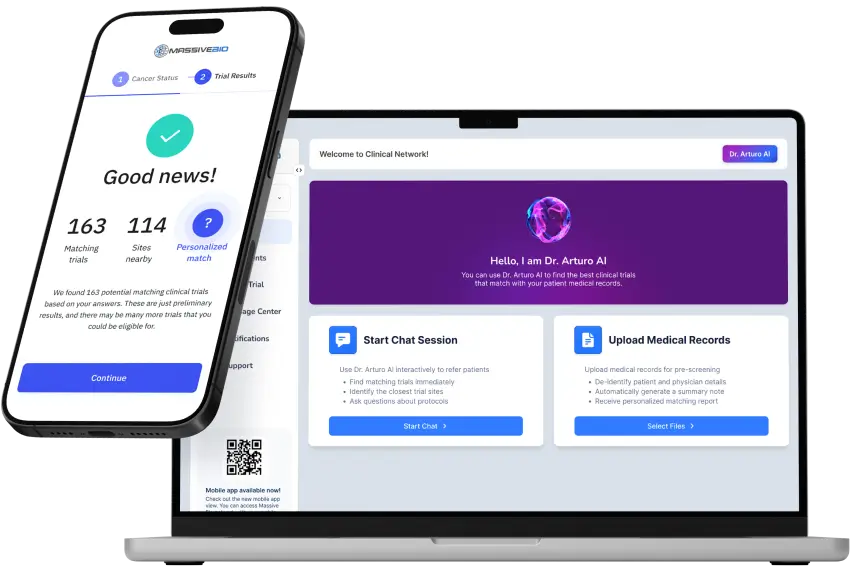
Bispecifics will be replaced with trispecifics in the near future due to their high success rate in clinical trials. To find out more regarding MM trials speak with your local oncologist or access the Massive Bio Oncology website. Massive Bio collaborates with 17 top pharmaceutical companies and over 130+ global partners and uses AI to determine which trial matches your current health condition vs ongoing trials. Website: https://www.massivebio.com
Next Steps if CAR T Doesn’t Work
If your myeloma relapses after undergoing CAR T therapy, your doctor will go through your past chemotherapy history to determine what options might be the best next step for you. With today’s advancements and new FDA approvals, physicians have begun using CAR T at earlier stages of disease. This means that conventional chemotherapy options may still be available in patients that have relapsed after CAR T. “In rare cases, it is also possible to re-try another CAR T therapy,” Dr Khan said.
Chimeric antigen receptor T-cell therapy is an innovative treatment that uses your own immune system to fight cancer cells. While it has shown promising results, myeloma remains an incurable cancer, and it can return even after CAR T. We talked to experts about what to do if this happens.
“In patients with multiple myeloma when the standard chemotherapy or stem cell transplantation has failed, what we are trying to do by using CAR T is using our body’s own immune cells to fight the cancer cell.”
The process works by collecting white blood cells known as T-cells from the patient’s body in a procedure called apheresis. Next, these immune cells are sent to a manufacturing lab and genetically modified to identify and attack cancer cells – “as if we have given an ‘eye’ to the T cells so they can now ‘see’ the myeloma cells,” Dr. Ganguly added.
Once these cells are ready, which takes approximately 28-35 days, the patient receives a dose of mild chemotherapy to prepare the body. Then the CAR T cells are re-infused back into the body. Now, the cells will seek out the myeloma cells, latch onto them, and kill them.
“I call it like a video game, Pac-Man – the cancer cells can run but cannot hide. And that’s how the CAR T works. The ‘CAR’ is the surface instrument, the eye that we have introduced via the genetic manipulation, and the ‘T’ stands for the T-cell,” Dr. Ganguly said.
Patients might experience side effects such as a fever, headaches, or seizures. But typically, these abate within seven to 10 days.
The Future of CAR T for Multiple Myeloma
A great deal of research continues to focus on how to best improve the success of CAR T therapy.
“When I was a medical student, on average a patient would have a life expectancy after diagnosis of two-and-a-half to three years,” Dr. Ganguly said. “And now we have progressed so much that it is not unusual for me to see a patient with multiple myeloma 20, 30 years of diagnosis and doing extremely well. And this happened because of advances in the medications and immunotherapy technology and clinical trials.”
Without the clinical trials of yesterday, Dr. Ganguly said, we would not have a standard of care for today. Today’s clinical trials will become the standard of care for tomorrow, and that’s how we continue to push the envelope. Always ask your doctor what kind of clinical trials might be available to you. Although multiple myeloma is still considered incurable, it is possible to have a very good quality of life for many years.



 Join
Join


 Your Privacy Choices